
What Wilkes Deed Records Convey
Deed research in Wilkes County rewards patience. A deed tells you who sold, who bought, and when the county recorded the transfer. Wilkes County deed records trace those moves through grantor and grantee names, parcel numbers, and each instrument's book and page reference. One deed answers one question. A full ownership history takes a chain. You can search Wilkes County deeds by grantor or grantee online through the statewide index, or turn to the courthouse for older books and certified copies. Start with an address or a parcel if you have one. Then let the names carry you backward.
| Deed Type | What It Does | Common Use |
|---|---|---|
| Warranty deed | Conveys the stated interest with warranties written in the instrument | Arm's-length transfer |
| Quitclaim deed | Conveys whatever interest the grantor may hold | Family transfer or title cleanup |
| Executor or administrator deed | Conveys estate property through an authorized fiduciary | Probate sale or distribution |
| Security deed | Secures a debt against real property | Financing, not a sale by itself |
| Tax deed | Records a conveyance tied to a tax-sale process | Delinquent-tax proceeding |
Wilkes Deed Index Search Modes
The GSCCCA Real Estate Index is the main online route for Wilkes County deed records. Its landing page offers name, book/page, property, and premium instrument-type searches. Scopes include county, regional, and statewide options. Statewide documentation describes transactions from all Georgia counties beginning January 1, 1999. Some 1993 through 1998 material is being added. That statement covers Georgia as a whole, not a Wilkes-only image cutoff.
| Search Mode | Best Starting Detail | Likely Use |
|---|---|---|
| Name search | Grantor or grantee name | Find transfers tied to a person or entity |
| Book/page | Exact recorded citation | Return to a known instrument |
| Property search | Property detail accepted by the portal | Narrow land-related entries |
| Instrument type | Document category and date range | Separate deeds from related filings |
Spelling is a key risk in any deed search. Try surname variants, entity suffixes, and trust wording. Match the names on the latest instrument you hold. If an expected result is absent, change the search mode before concluding no record exists.
Build a Wilkes Deed Chain
A chain of title is an ordered sequence of instruments. Those instruments moved an interest in the same land. It starts with a known, recent deed. From there, step backward through the people or entities named in it. The parcel number, legal description, and book/page citation keep one tract distinct from land owned by someone with the same name. Those anchors matter most in a county where surnames repeat.
- Find the latest deed and confirm its parcel or legal description.
- Read the grantee as the receiving party and the grantor as the transferring party.
- Search the grantor as a grantee in an earlier date range.
- Match the description and recording references, then repeat the process.
- Grantor
- The party conveying the stated interest.
- Grantee
- The party receiving the stated interest.
- Chain of title
- The linked sequence of conveyances for the same land.
- Book and page
- The recorded location used to retrieve an instrument.
- Instrument number
- A separate identifier assigned to a recorded filing where used.
A tax mailing address or GIS sale entry can supply a lead. Neither replaces the grantor-grantee trail. Use the Wilkes County former owners route when the goal is a deep backward reconstruction rather than one deed.
Wilkes Deeds at the Courthouse
The local custodian is the Wilkes County Clerk of Superior Court. The address is 23 Court Street, Room 301, Washington, Georgia 30673. Published hours are Monday through Friday, 8:00 a.m. to 5:00 p.m. The telephone number is 706-678-2423. The Real and Personal Property Division explains the local role for deeds, plats, liens, UCC filings, and transfer reports.
GSCCCA states that Georgia Superior Court offices provide full database access at the courthouse. The exact Wilkes public-terminal practice is not published. So call ahead before counting on a terminal. The Clerk is also the fallback for anything not shown online. That could be a certified copy, an older book, or a puzzling index reference. A focused request should include names, a date range, deed type, and any book/page, parcel, or legal-description clue.
Online Wilkes Deed Access Costs
Online summary access and document images are not the same product. GSCCCA describes a free limited-use account with restricted summary access and no images. A regular account runs $14.95 per calendar month per user. Premium costs $29.95 per month. A single-use account costs $5 for a four-hour window. Image printing is listed at $0.50 per page. These are statewide system charges, not a quoted Wilkes County certified-copy schedule. So confirm copy and certification costs with the Clerk.
For a narrow need, collect the exact book/page or instrument reference first. That one step saves search time. It also reduces the risk of paying for the wrong image.
Note: A portal fee buys access or an image; it does not turn an index result into a legal opinion.
See the Wilkes Recorder Route
Wilkes County splits its recording work across local and statewide channels. The county division page shows where local recording duties and the statewide search route meet. View the official Clerk division source before choosing the correct request channel.
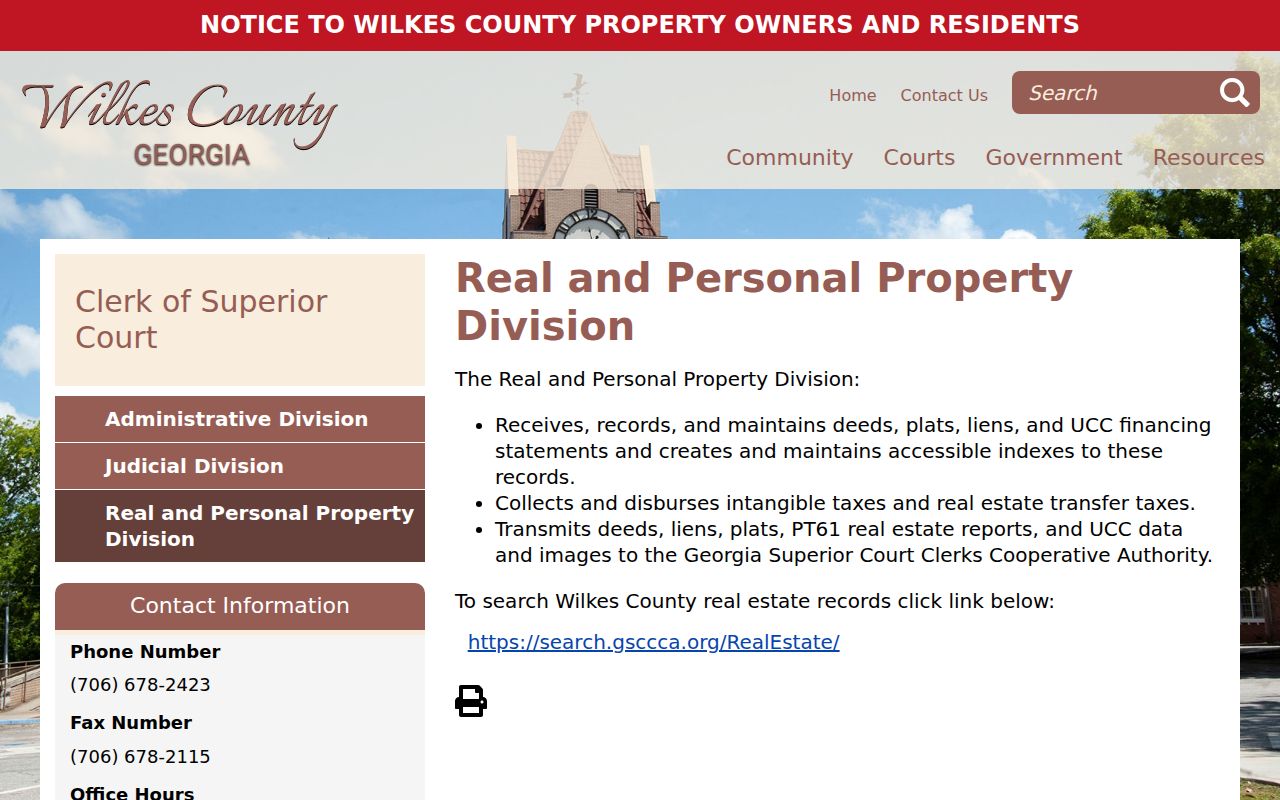
The county page is a routing aid, not a deed image. It helps distinguish the county custodian from the GSCCCA search system that receives transmitted index data and images.
Wilkes Estate Deeds Need Context
An ownership change after death may involve more than a single ordinary sale. Wilkes Probate Court has jurisdiction over estate administration. It also oversees the sale or disposition of estate property. Wills, appointments, returns, and orders can explain the authority behind a later deed. They can show why an executor or administrator signed it. Begin with the recorded conveyance. Then use the probate file to explain the authority behind it.
A loose estate paper or obituary is only a lead. The deed and the official court record supply the stronger link. Quiet-title, partition, foreclosure, or disputed ownership matters may also lead to Superior Court records. Those disputes can end in a later deed or order.
Wilkes Deeds From 1750 to 1850
Older Wilkes County deeds reach back further than most people expect. The Hargrett Rare Book and Manuscript Library at the University of Georgia keeps a Wilkes County deed index spanning 1750 through 1850. Its finding aid lists grantor, grantee, instrument type, date, page, and acreage for each entry. That acreage field is a quiet gift. Modern street addresses simply do not exist for most of this era. So acreage and party names carry the search instead. Work from a known party, an acreage clue, or an old land description. Then go back to the official deed book for the full instrument. The historic index points you toward the evidence. It is a pointer, not a substitute.
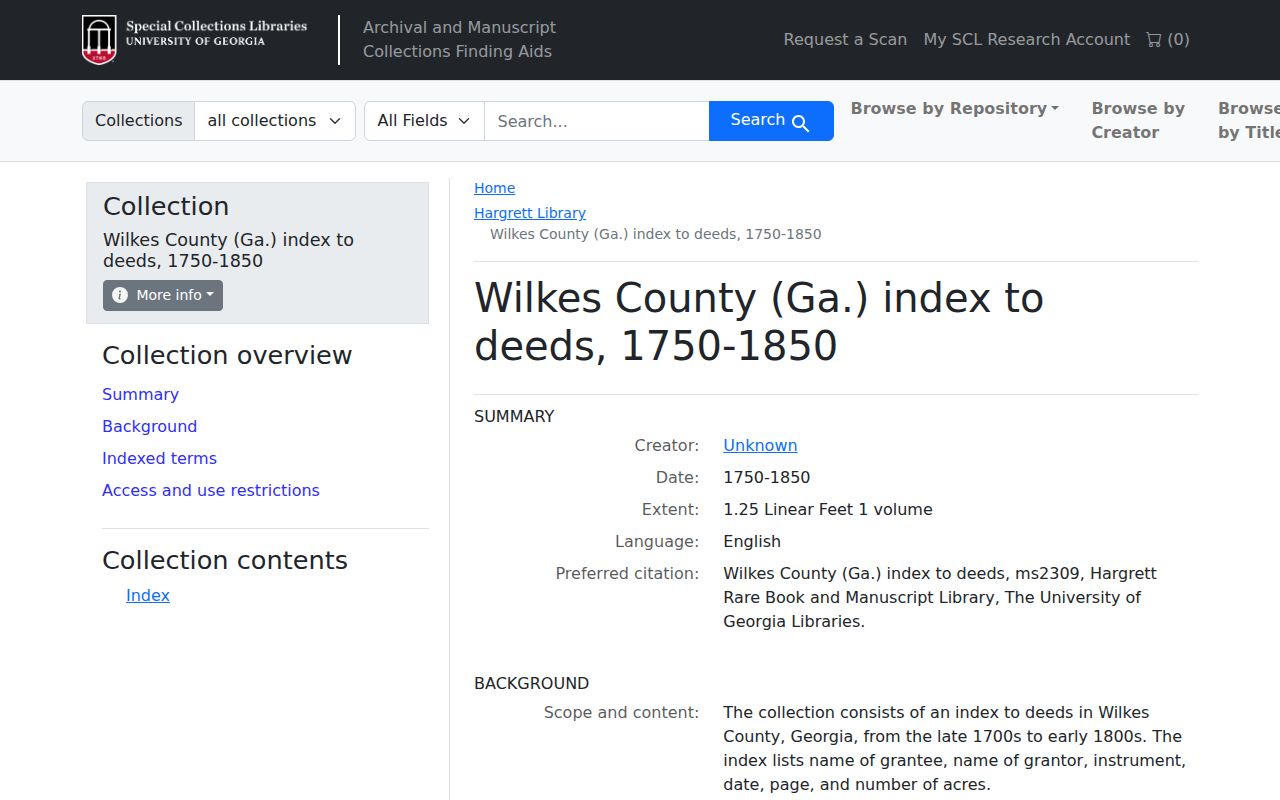
The archive finding aid for Wilkes County stretches deed research far past the statewide index's modern coverage. Its entry carries recorded instruments reaching back to 1750, opening the oldest layer of the county's land records.
Older Wilkes Land Record Clues
Beyond deeds, the Georgia Archives and its Virtual Vault hold tax digests, court papers, and estate files. These materials sharpen a Wilkes County property search. A 1787 tax digest is digitized, and the Archives also flags one from 1791. The Toomey collection gathers deeds, title bonds, mortgages, inventories, divisions of property, annual returns, receipts, and fi fas. These documents come from several court traditions.
The Archives cautions that its loose papers are not complete case files. It points researchers back to the official record books. At the Mary Willis Library, Washington newspapers, family memorabilia, and rare Wilkes and Georgia history fill in names, roads, acreage, and family links. Written genealogy requests may carry copy and postage costs. Every clue, though, should lead back to a deed book, plat, tax digest, or court entry. Make that check before you rely on it.
No official Wilkes County source documents a courthouse fire or any total loss of records. That silence matters. Don't skip an era or repeat a fire tale without a citation. When a deed goes missing, test the spelling. Widen the date range as well. Check the county scope, and confirm which instrument types carry images. Then ask the Clerk to search the official index.
Note: The Archives' loose papers supplement the record books but never replace them.
Obtain a Wilkes Deed Copy
Start with the online image whenever one exists and a plain copy will do. For certified copies, records with no image, or anything outside the visible range, contact or visit the Clerk. A mailed or open-records request should pin down the record precisely. Include the grantor, the grantee, the approximate date, and the document type. Add the book and page or instrument number if you have it.
When a specific public record is not supplied through the standard index, the Georgia Open Records Act offers a path. The Attorney General's guide asks that requests identify the agency and the records sought. Agencies may charge reasonable search, retrieval, copying, and administrative costs. The law also sets a three-business-day window for a response. A notice is required when immediate production is not possible.
For mail, include a return address. Ask the office to quote any copy or certification charge before work starts. In person, bring the index citation and enough property detail to separate your tract from its neighbors. The Clerk cannot give legal advice. Staff can, however, identify the record the office holds and explain how to get your copy.
Recorded does not mean guaranteed. Wilkes County deed records show filed instruments. They do not reveal every unrecorded claim and are not a survey or title opinion.