
What Wilkes County Property Tax Records Reveal
Wilkes County splits the work. Appraisal and collection sit with two offices at the courthouse in Washington. The Tax Assessor sets fair and equitable values, reviews returns, and administers exemptions. The Tax Commissioner, in turn, collects real-property, mobile-home, and timber taxes. A complete look at property tax records follows the parcel from appraisal record to bill, rather than treating one screen as the whole file.
| Field | What It Shows | Where |
|---|---|---|
| Fair market value | The assessor's estimate of full property value | Tax Assessor parcel record or notice |
| Assessed value | The taxable valuation basis, generally 40% of fair market value in Georgia | Tax Assessor |
| Exemption or covenant | Approved tax treatment that can change taxable value | Tax Assessor |
| Bill and payment status | The amount billed and collection information available for the selected year | Tax Commissioner |
| Digest and levy history | Countywide totals and annual levy context, not an individual appraisal | County document library |
A sale price records one deal. Fair market value is the assessor's conclusion, assessed value is the statutory tax base, and the bill applies the levy after exemptions and any special treatment. None of these figures stands in for another.
Wilkes Tax Offices Split Their Work
Questions about parcel characteristics, value, a return, or an exemption belong with the Wilkes County Tax Assessor, 23 Court Street, Room 205, Washington. Payment and collection questions go to the Tax Commissioner at 23 Court Street. Each office publishes a phone route: the assessor at 706-678-7732, and Tax Commissioner Lisa Dozier's office at 706-678-2422.
The assessor's hours run Monday through Friday, 8:00 a.m. to 5:00 p.m. The payment site's coverage of older bills, plus any convenience fees, is not stated up front. Calling with the parcel number and tax year is the dependable fallback when the web route falls short.
Note: Ask the assessor about value or exemption decisions and the Tax Commissioner about amounts billed, paid, or still collectible.
Wilkes Property Tax Starts at 40 Percent
Georgia property is generally assessed at 40 percent of fair market value. A statutory special assessment can override that. Picture a $100,000 fair market conclusion from the assessor. That ordinarily yields a $40,000 assessed value before exemptions or special programs. The gap between the two figures is routine. It shows up throughout property tax records.
- Fair market value
- The assessor's estimate of full value under Georgia appraisal rules.
- Assessed value
- The valuation basis used in calculating tax, generally 40 percent of fair market value.
- Levy or millage
- The rate applied to taxable assessed value by the relevant taxing authority.
- Tax lien
- A claim arising from unpaid tax; it should be checked through official collection and recorded-record routes.
Special assessments can break that simple ratio. Current-use, conservation, forest, and historic-property programs may value eligible land under different rules or covenants. A surprisingly low assessed figure is a signal to check exemption and covenant status. It is not proof the parcel could sell for that amount.
Open the Wilkes Property Search With Caution
The Georgia Department of Revenue's property records directory points Wilkes County users to qPublic. The directory itself serves as the state's official routing page for county property search destinations. Exact labels, required fields, downloadable reports, and historical coverage at the qPublic destination should not be assumed.
The state directory displays the authorized assessor link for each Georgia county:
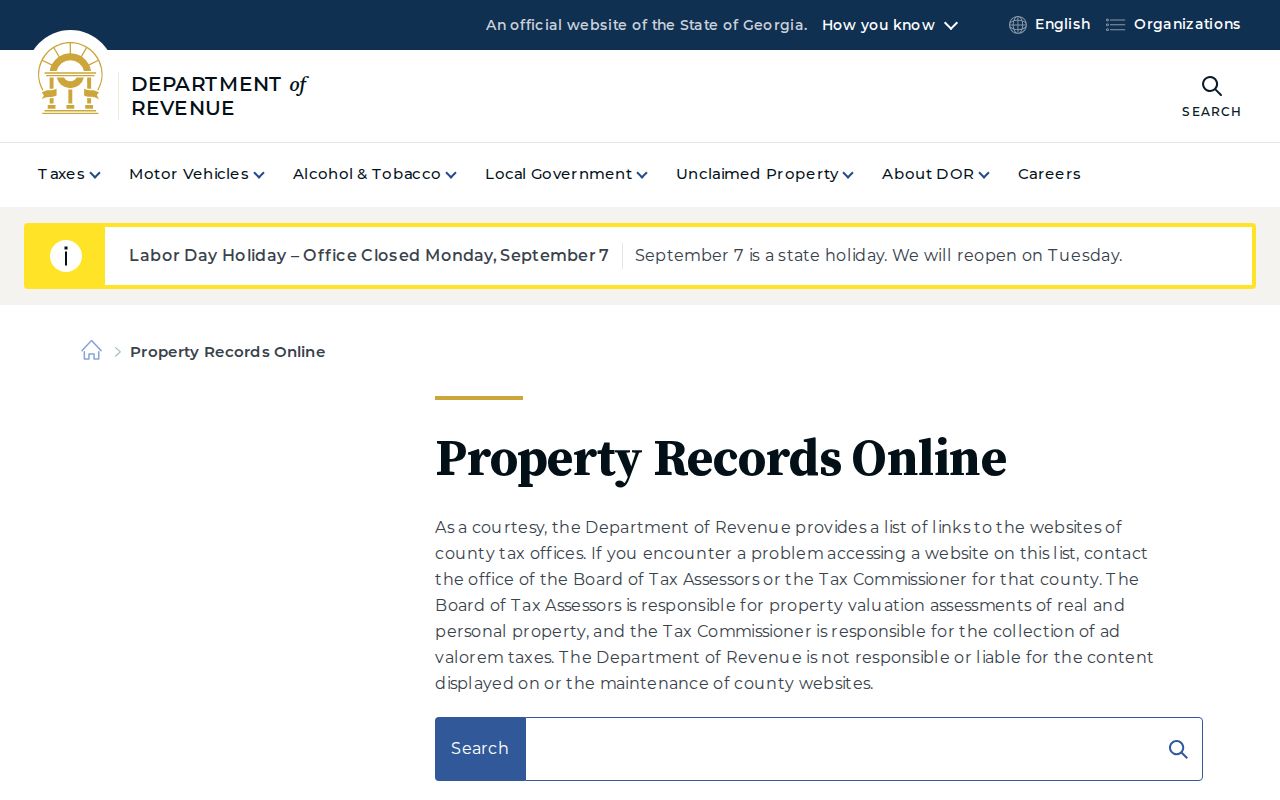
Confirm the authorized assessor destination through the directory. Then record what the current Wilkes result actually displays. If it fails, request the parcel record by phone or at Room 205 rather than substituting fields from another county's qPublic site.
Wilkes Homestead Tax Forms Supply Record Clues
The county homestead application shows the data that ties an exemption request to a parcel: owner and spouse names, situs address, map or parcel number, lot or acreage, purchase date and price, lien amount, land lot and district, title type, and deed book and page. It also asks about business or rental use and the exemption category claimed. Each field doubles as a clue for deed records and the plat.
| Form detail | Why it helps |
|---|---|
| Map or parcel number | Joins the application to the appraisal and bill records. |
| Deed book/page | Points to the recorded acquisition instrument. |
| Purchase date/price | Provides a transaction clue to compare with the parcel history. |
| Land lot/district | Helps distinguish rural tracts with similar mailing descriptions. |
Do not overread an exemption. Approval supports a claimed owner-occupancy tax benefit, but it is not conclusive proof of present occupancy or title.
Look Up a Wilkes County Tax Bill
The county's official Pay My Bill page directs users to Wilkes County Pay. Property tax is the initial choice there, though the account-search and result fields may not render reliably. Keep the address, parcel number, owner name, and tax year close at hand.
- Start with the assessor record and copy the parcel identifier exactly.
- Choose Property Tax in Wilkes County Pay and use only the fields currently offered.
- Match the returned owner, parcel, and year to the assessor information before relying on the bill.
- Review collection status, then contact the Tax Commissioner for older years, delinquency details, receipts, or fees not visible online.
- Assessment notice
- The valuation notice from which the statutory appeal period runs.
- Tax digest
- The countywide roll used for levy and reporting purposes.
- Homestead exemption
- An approved form of owner-occupancy tax relief, subject to eligibility.
- Payment status
- The collector's current information; confirm a formal receipt directly when proof matters.
Wilkes Tax Levy Files Are Context
The county document library carries annual Property Tax Digest and Five Year History of Levy material. It includes files for 2024 and 2025 and earlier five-year histories. Those publications let readers compare countywide digest totals and levy changes over time. They do not replace the assessor's record for a specific tract. Nor do they stand in for the Tax Commissioner's account on a specific bill.
Use a levy history to grasp the public calculation environment for a year. Then return to the parcel record for class, value, exemptions, and jurisdiction. City levies can differ. So a Washington address alone does not establish that a parcel lies inside Washington's municipal boundary.
Note: A postal city and a taxing jurisdiction are different facts; verify the parcel's actual boundary and tax districts.
Research Wilkes Tax Delinquency With Care
Wilkes County publishes no dependable delinquent-tax list, searchable tax-sale inventory, redemption status screen, or sale calendar. An unpaid-looking portal entry does not prove that a levy, sale, or deed has occurred. Start with the Tax Commissioner. Identify the exact parcel and years. Ask what official document states the account's status.
If a sale or dispute emerges, widen the search with care. The Clerk's real-estate index may hold relevant liens or deeds, while Superior Court records may contain a tax-sale redemption or challenge. A docket entry is not a deed. A tax notice is not a final title determination. Obtain the actual instrument or file from its custodian.
Appeal a Wilkes County Assessment on Time
Georgia law sets a 45-day window to appeal an assessment notice. The clock runs from the mailing date under O.C.G.A. §48-5-311. The Wilkes County Board of Tax Assessors sets the value. The Department of Revenue then reviews equalization. An appeal can rest on value, taxability, uniformity, a denied exemption, or a covenant question. All fall within the PT-311-A framework.
Keep the notice and its envelope. Pick your ground early. Then build parcel-specific evidence: the property card, photographs tied to the valuation date, comparable parcels of similar class and improvements, a recent arm's-length sale record, or a survey where acreage is disputed. Records of damage or poor condition also help. Your asserted value should be reasoned and documented. It should not be a round guess pulled from thin air.
Protect the deadline. File with the Wilkes County Board of Tax Assessors within 45 days after the assessment notice was mailed; confirm delivery requirements with the office.
Compare Wilkes Tax Value and Sale Price
A careful review leans on three records. The assessor supplies valuation and parcel characteristics. A deed or PT-61 trail documents a transfer and may reveal transaction details. The Tax Commissioner handles billing and collection status. When the figures disagree, timing is often the cause. Other explanations include a non-market transfer, a special assessment, an exemption, new construction, or incomplete online data.
The Wilkes GIS schema works well as a cross-check. It carries fields for value components, sale date and price, owner, situs, mailing address, acreage, and building data. Still, a REST field can sit empty or stale. Note the date you viewed the record, keep the parcel number handy, and confirm any consequential figure with the assessor. That approach respects local data without turning a map attribute into an official appraisal conclusion.