
Trace Wilkes Former Owners Backward
Work the ownership trail backward from a known current deed. Each transfer should be copied from the real record. A GIS sale-history field alone is not enough to assume anything. The grantor on one matched instrument simply becomes the next grantee to chase.
| Transfer Date | Grantor to Grantee | Deed Type | Book/Page |
|---|---|---|---|
| Newest matched date | Prior owner to current grantee | As recorded | Exact citation |
| Earlier matched date | Earlier owner to prior grantee | As recorded | Exact citation |
| Next earlier date | Continue only after the land matches | As recorded | Exact citation |
A sale date or an owner name alone proves little. Match the legal description, acreage, lot and block, land lot or district, and adjoining-owner calls wherever they appear before accepting a link in the chain.
Reconstruct Wilkes Ownership History
The GSCCCA Real Estate Index offers name, book and page, property, and premium instrument-type modes. Name search moves you between parties; book and page returns you to a known deed.
- Find the latest matching deed and record its grantee, grantor, date, type, book/page, and description.
- Search the grantor as a grantee in an earlier date range.
- Open likely entries and reject any that describe different land.
- Repeat until the online trail ends, then carry the last firm citation to older books and finding aids.
- Grantor
- The party that conveyed the stated interest.
- Grantee
- The party that received it.
- Chain of title
- The linked sequence of instruments for the same land.
- Reverse index
- An index arranged to help trace through the receiving or conveying party.
- Quitclaim and warranty deed
- Different forms of conveyance with different promises; neither label alone proves a clean chain.
Wilkes Ownership Records Across Time
GSCCCA's statewide documentation places the real-property transaction index at all Georgia counties beginning January 1, 1999. Some 1993 through 1998 history is still being added. No official Wilkes-only earlier online cutoff exists. Treat the statewide date as a floor, not a promise that every Wilkes image starts there. The Clerk of Superior Court keeps the local recorded books and indexes. Statewide guidance says Superior Court offices provide full database access on site. Call the Wilkes Clerk at 706-678-2423 about terminal practice, an older deed-book reference, or copy access. Do that before you drive over.
Online is not the full time span. The Wilkes-specific cutoff is unverified. Older former owners may require deed books, archive finding aids, tax digests, or microfilm.
Old Wilkes Descriptions Beat Addresses
Historic land often lacks the modern street number used today. Follow the legal description instead. Lot and block can point to a recorded subdivision plat. Rural instruments lean on metes and bounds, acreage, land lot or district, roads, waterways, and adjoining owners.
An earlier deed may name neighbors who later became grantors or grantees. A plat can preserve a subdivision name that faded from daily use. Compare each clue with the current parcel PIN, GIS shape, and deed book reference. Still, never force an old tract onto modern geometry without survey evidence. The Wilkes GIS technical layer carries PIN, parcel ID, account, book and page, and acreage. It also holds owner, situs, mailing, sale, and value fields. Copy those identifiers before opening older books. A null field or a recent sale entry is a clue, not a full history. GIS geometry is a tax reference. It cannot fix the exact boundary of an old metes-and-bounds tract.
Wilkes Plats Preserve Prior Parcels
Plats explain what deeds alone cannot. They cover splits, combinations, road layouts, easements, and lot numbering between previous owners. The Clerk records plats and transmits them to GSCCCA. Search by known names, subdivision wording, or book and page references pulled from a deed.
A plat beats a marketing neighborhood name. Even a recorded plat, though, will not state every later title event. Use it to keep the land constant while the deeds change the parties. Then lean on a current survey plus professional title work when boundary certainty matters.
Probate Breaks a Simple Wilkes Chain
Some former owners never transferred land in an ordinary sale. Wilkes Probate Court handles estate administration and the sale or disposition of estate property. An executor or administrator deed may rest on an appointment, order, return, or other probate record.
Search the decedent's name, the estate, the fiduciary, and the deed grantee. Match any court authority to the later recorded instrument. A will or loose estate paper gives context, but it does not by itself prove title reached a later owner. Quiet-title and partition actions can also alter or clarify the chain. Georgia Courts lists Wilkes Superior Court through its eAccess directory, though the redirected provider requires an account. For the official case file, disposition, certified copy, or older material, use the Clerk. A caption may reveal the parties, yet the resulting order and later recorded instrument show how the land record actually changed.
Wilkes Liens Along the Chain
Mortgages, security deeds, liens, releases, and fi fas can sit between ownership transfers. They may explain financing, a release, a foreclosure, or a corrective filing. They do not create a new former owner. Keep a separate event list for encumbrances. Record the filing type, parties, date, and release reference. Then return to the deed chain for ownership. That habit keeps a lender, lien claimant, or secured party from being mistaken for a prior owner. It prevents a common mix-up.
Wilkes Deed Index, 1750 to 1850
The University of Georgia's Hargrett Library holds a Wilkes County deed index covering 1750 through 1850. The finding aid describes grantor, grantee, instrument, date, page, and acreage fields. Those details bridge former-owner research into an era long before street addressing.
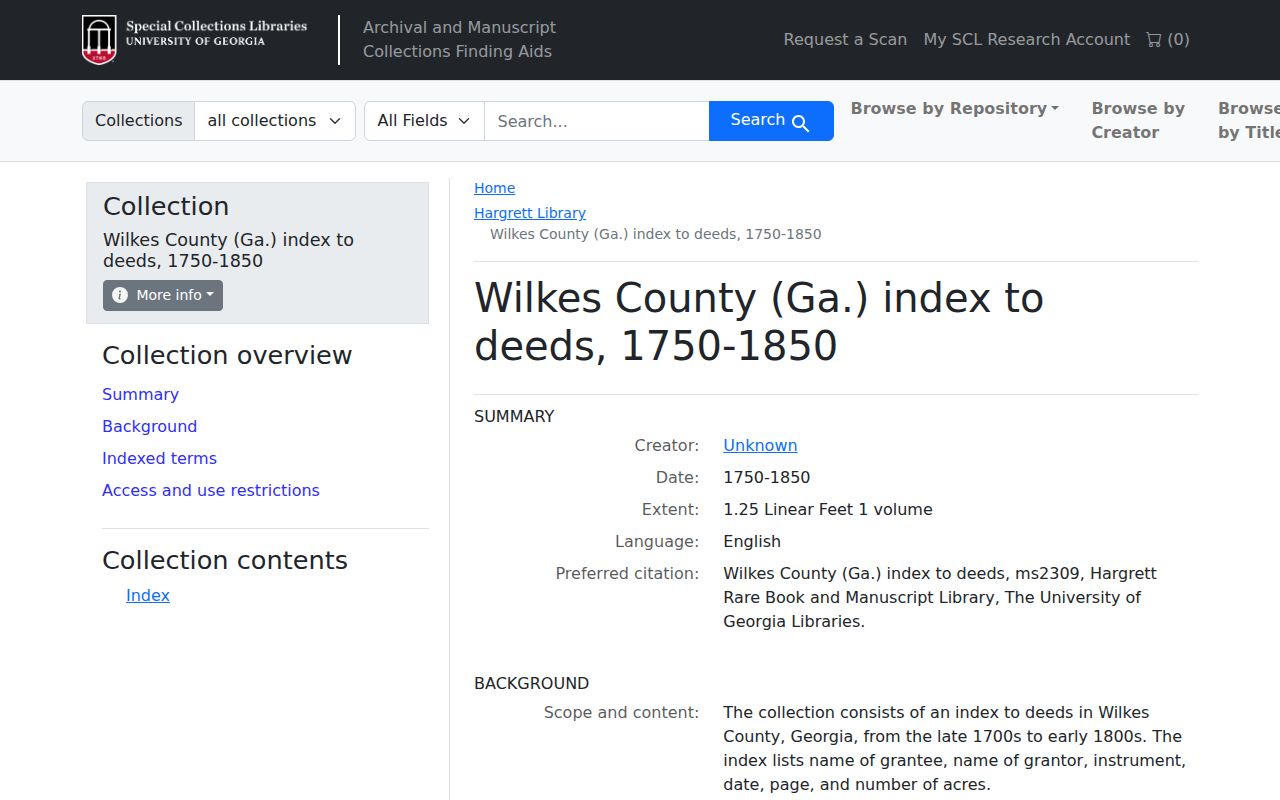
The finding-aid page displays the route to the index entries. Use its names and page clues to seek the full official record rather than treating an index entry as the complete deed.
Wilkes Archives Extend Former Owners
Beyond the courthouse, Wilkes County history lives in older digests and family papers. The Georgia Archives Virtual Vault holds a 1787 Wilkes County tax digest. It also highlights another from 1791. A digest can place a landholder in a given year. Deed records may prove difficult to follow before that. Keep in mind that tax responsibility and legal title are not the same thing. For property records before the deed books thin out, these rolls are a useful bridge.
The Toomey collection widens the lens. It gathers deeds, title bonds, mortgages, inventories, divisions of property, annual returns, and receipts. Fi fas appear in it too. The Archives cautions that these loose papers do not form complete case files. Researchers should return to the official record books. Mary Willis Library rounds out the picture with newspapers, family memorabilia, and rare Wilkes history. Written genealogy requests may carry copy and postage charges.
Set Limits on Wilkes Owner History
A backward chain of former owners is only as strong as its weakest land match. Similar names can fool you. So can changed acreage, missed corrective deeds, probate transfers, and gaps in online imaging. Any of these can point you toward the wrong former owners. Record every citation as you go. Flag each link you are unsure of.
When a known book or instrument is not online, other routes still work. Use the phone, mail, an in-person visit, or a Georgia Open Records Act request. The Clerk is the custodian for Wilkes County deed records. Archives and libraries serve as supporting research routes. A surveyor can settle boundary questions. A title professional or attorney can assess legal ownership.
No Wilkes County courthouse disaster or total records loss appears in any official account. So do not invent a fire gap when an index search comes up empty. Test spelling variants. Try exact book and page citations, nearby dates, county scope, estate names, and instrument types. Then ask the Clerk to inspect the official index or the deed book itself. A missing web image does not mean a missing record.
Use ownership history lawfully. Trace prior owners for house history, estate work, title research, and property diligence, never to stalk, harass, or harm a living person.