
Identify a Wilkes County Owner
The Wilkes County Tax Assessor is the fastest first stop for a property owner lookup. Its parcel records tie a name to a map and parcel number. That keeps a property search honest when similar names or neighboring lots muddy the water. The GIS map helps confirm the tract's shape and location. For the recorded word on title, the Clerk's deed index shows the transfer that created the current owner of record. The deed book and page anchor it. Hold onto the parcel number and legal description as you go.
- Search the address through the official Wilkes qPublic route and note the owner label and parcel PIN.
- Check the parcel in county GIS. Compare situs, mailing, acreage, and book/page fields.
- Run the owner or book/page in the GSCCCA Real Estate Index and locate the newest relevant deed.
- Read the grantee, recording date, and legal description. Resolve any company or estate name through its official file.
One caution is worth noting. The assessor's parcel roll can lag behind a freshly recorded deed, so when dates conflict, the newer deed in the deed records is the stronger lead, though real title questions may call for a professional review.
Wilkes Assessor Owner Label
Georgia's Department of Revenue directory routes Wilkes County parcel data through qPublic. The official qPublic destination is where the county's parcel cards live. Search there by owner name, address, or parcel number. If a card will not render or looks stale, the Tax Assessor at 706-678-7732 can help. That office keeps the data current.
Each parcel card ties an owner of record to a situs address. It also lists a map or parcel number. It also carries acreage, purchase details, land lot or district, deed book and page, and exemption facts. Together those fields describe the land. An owner label or exemption claim is not conclusive proof of title, though. For a Wilkes County property owner lead, the assessor's qPublic page is the place to start.
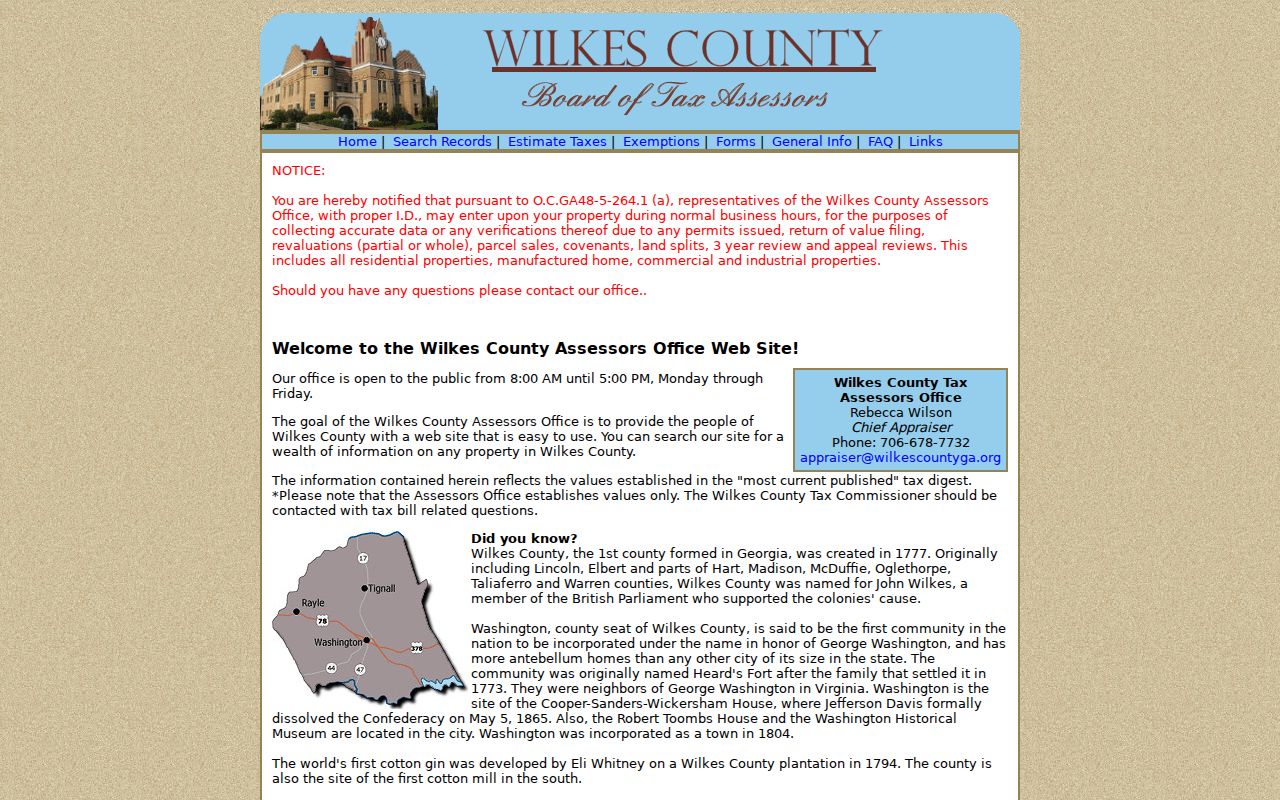
The image confirms the qPublic destination. The deed in the Clerk's deed records remains the next step toward recorded ownership.
Trace Wilkes Owners to Deeds
Deeds, plats, liens, and PT-61 reports all pass through the Wilkes County Clerk. The Clerk records them and forwards both data and images to GSCCCA. That makes the GSCCCA Real Estate Index the natural next stop. You can search it by name or by book and page. Statewide documentation describes transactions going back to January 1, 1999. Older material is being added over time. There is no Wilkes-specific imaging cutoff, so coverage depends on what has been transferred.
The grantee is the person receiving an interest in the deed. Check that name against the parcel card, along with the legal description and the date. A deed can convey less than full ownership. It can also reserve an interest. It can even list several grantees at once. The index summary only finds the instrument. Reading the deed itself is still essential.
Note: GSCCCA may charge account and image fees online. Superior Court offices offer full database access at the courthouse.
Follow Wilkes Mailing Clues
The GIS Parcels layer carries a lot of detail. It lists owner, mailing address, situs, city, ZIP, PIN, account, book and page, sale, acreage, and value. Mailing and situs often differ. One tells you where the tax bill goes; the other shows where the land sits. Neither one proves who actually lives there.
Postal cities can mislead too. Washington 30673, Tignall 30668, and Rayle 30660 are postal anchors rather than municipal boundaries. Before assuming which city or authority handles permits, compare the address against the parcel geometry. For the full mechanics, use the Wilkes County property search.
Wilkes County Ownership Sources
No single screen answers every meaning of "who owns this property." Use each source for its intended role, then compare results against the same parcel key.
| Where ownership appears | What it contributes | How current |
|---|---|---|
| Assessor roll | Owner label, mailing address, parcel context | Current roll, but may lag a sale |
| Recorded deed | Grantee, legal description, transfer terms | Tied to recording date |
| GIS parcel layer | Mapped tract, owner label, PIN and deed clues | Reference data with no stated refresh date |
| Business filing | Entity status, agent, officers, filed documents | Entity record, not land title |
The owner of record is not always the occupant. Someone can lawfully use a site without holding title, and ownership can also be split among several people or entities.
Wilkes Trusts and Company Owners
Deeds in Wilkes County often vest land in an entity rather than a person. An LLC, a trust, an estate, or a life estate can show up as the owner of record. Copy the wording exactly as the deed spells it, then try abbreviations and dropped punctuation. Georgia's business registry helps here. The Georgia business search returns entity status, officers, registered agent, addresses, and filings for Georgia companies. Remember what that record proves. It identifies the entity itself, not the people who own its assets.
The vesting language matters in every case. A trust deed names a trustee, while beneficiaries stay hidden. An executor may sign for an estate. A life-estate deed splits current use from a future remainder interest. So read the vesting words closely. They state how the interest is actually held.
Wilkes Probate Owner Transfers
The probate side of a Wilkes County transfer matters when the tax roll lists a deceased owner or an entry reading "Estate of." That is the cue to pull probate records. Then circle back to the deed itself. A will, a year's support matter, an estate sale, or a court order can each show how the land moved. The recorded conveyance still carries the most weight.
The Probate Court handles estate administration and any sale of estate property in Wilkes County. Call 706-678-2523. The court publishes no online probate index, so ask the office directly for access. Georgia Archives can help with historic estate papers. Its Virtual Vault notes that loose Wilkes court and estate files are incomplete.
Note: Probate records can explain an owner transfer, but the recorded land instrument remains the controlling record.
Wilkes Owner Terms Defined
Ownership records lean on short terms that carry different legal weight. Telling them apart keeps a quick owner lookup from turning into an unsupported title claim, and the difference matters in Wilkes County deed records.
- Owner of record
- The name shown on the current assessor roll.
- Grantee
- The party receiving the interest stated in a deed.
- Vesting
- The words describing how the grantee holds an interest.
- Situs address
- The parcel location, distinct from the mailing address.
- Title
- The legal ownership interest, broader than an index name.
These are working definitions only, and they cannot settle an ambiguous deed, lien, inheritance claim, or boundary dispute.
Resolve Wilkes Owner Record Conflicts
Conflicting owner names are common in Wilkes County. The assessor roll can lag a recent closing. A recorded deed may sit unindexed. GIS may follow its own update schedule. Parcel splits create further confusion, since a parent tract can keep an old owner or account label while fresh parcel numbers work through the tax and mapping systems. Compare dates before deciding which name stands as the owner of record.
A reconciliation sheet settles most Wilkes County property records questions quickly. Write down each name exactly as spelled, entity abbreviations included. Add the mailing and situs addresses, the PIN or account number, deed book and page, and the legal description. Note the sale date and when each source was viewed. Scrutinize the joint-owner, trustee, estate, and life-estate wording. One changed suffix can mean a different indexed party.
When qPublic is unavailable, the Tax Assessor can print a current parcel card by address, PIN, or owner. A GSCCCA image behind an account gate still leaves a book and page clue for the courthouse workstation or a copy request to the Clerk. GIS outages often yield to the county's REST metadata. Raw field names never prove the live owner. The focused steps for checking who owns now continue on the Wilkes County current owner page.
Note: Preserve the source date and parcel key whenever owner names conflict across Wilkes County records.
Limits of Wilkes Owner Lookups
A public owner label has real limits. It names an owner of record. It does not confirm occupancy, clear title, exact boundaries, land condition, or anything a title opinion covers. The Wilkes County tax roll serves assessment, the GIS map serves reference, the deed index points to instruments, and the assessor accepts non-disclosure requests under O.C.G.A. §§50-18-72 and 50-18-78 from eligible applicants.
Lawful use. A Wilkes County owner lookup supports property research, purchase diligence, estate work, and civic transparency. Never use owner information to stalk, harass, intimidate, or harm anyone.
Even the freshest data can be wrong. A deed may have been recorded but not yet indexed, an assessment change may be pending, or a new parcel split may lag across the systems. Wilkes County updates do not land everywhere at once. Date each result. Keep copies of the deed book and page, PIN, and other references, and for a recent transaction call the Clerk and Assessor instead of reading a mismatch as wrongdoing.
Commercial data summaries add their own delay and can merge people with similar names. The official trail is cleaner. Wilkes County assessor, Clerk, GIS, business, and probate sources each tie a fact to its custodian, which makes the audit path easy to follow. Mismatches are usually timing, not fraud. For purchase, estate, lien, or disputed-title work in Georgia, an attorney or title professional can examine the full chain and its exceptions.